Predatory Academic Conferences: A Cross-National Analysis of Researcher Exposure and Verification Deficits in the United States and Malaysia
How fake scholarly meetings exploit the publish-or-perish economy, and what institutional verification frameworks can do about it
ScholarVault.in Academic Integrity Division, India

Abstract
Predatory academic conferences have grown from a marginal nuisance into a global integrity crisis, draining an estimated billions of dollars in wasted research funding and damaging the careers of researchers across at least 112 countries. This review synthesises findings from the InterAcademy Partnership's multi-year study, regulatory actions by the United States Federal Trade Commission, documented first-person scam reports from researchers in Malaysia and the United States, and institutional guidelines from universities in both nations. We find that predatory conferences share a consistent operational template: unsolicited flattery-based invitations, absent or sham peer review, fabricated committee memberships, tourism-oriented venues, and revenue models built entirely on registration fees. United States regulators have pursued legal remedies, culminating in a USD 50 million judgment against OMICS Publishing Group in 2019, yet enforcement has not halted the proliferation of new operators. In Malaysia, a 2024–2025 national study surveying 935 academics across public and private universities documented systemic exposure to predatory publishing and conferencing, prompting policy recommendations submitted to the Ministry of Higher Education. We propose an 18-point verification framework and argue that the gap between awareness and action is best closed by accessible, technology-assisted conference audit tools that serve researchers, institutions, and funding agencies simultaneously.
Keywords: predatory conferences; academic integrity; research fraud; conference verification; United States; Malaysia; scholarly communication
Introduction
The assumption that a conference bearing an academic-sounding name, a professional website, and a list of distinguished keynote speakers is a legitimate scholarly event has long been safe. That assumption is no longer warranted. Predatory conferences — events organised primarily to collect registration fees rather than to advance scholarship — have proliferated across nearly every scientific discipline, from Earth and space sciences to nursing, oncology, and materials engineering.
The InterAcademy Partnership (IAP), a network of over 140 science academies, conducted a two-year study surveying more than 1,800 researchers across 112 countries. Eighty percent of respondents reported that predatory journals and conferences either were already a serious problem in their country or were becoming one. The IAP estimated that at least one million researchers globally have fallen prey to predatory journals and conferences, and that these activities have wasted billions of dollars in research funding — encompassing registration fees, travel costs, accommodation, and the time and materials spent preparing presentations for events that delivered no academic value [1].
Of those surveyed by the IAP, 4 percent acknowledged having participated in a predatory conference, with 3 percent doing so unknowingly. Another 6 percent were uncertain whether they had attended one [1].
This article focuses on two national contexts that illustrate different facets of the problem. The United States represents the regulatory enforcement frontier: the Federal Trade Commission (FTC) filed charges against predatory conference operators in 2016, and in 2019 a federal court ordered OMICS Publishing Group to pay more than USD 50 million for deceiving researchers about peer review and editorial board composition [2]. Malaysia represents the institutional response frontier: a national-level study commissioned by the Ministry of Higher Education in 2024–2025 surveyed 935 academics about their experiences with predatory publishing and conferencing, producing policy recommendations for systemic reform [3].
The contribution of this review is threefold. First, it consolidates the fragmented evidence on predatory conference operations into a single cross-national comparison. Second, it documents first-person accounts from researchers in both countries who lost money and time to these scams. Third, it argues that the most effective intervention is not post hoc regulation but pre-commitment verification — tools and institutional policies that prevent researchers from submitting to or registering for predatory events in the first place.
Methods
Study Design
This is a structured narrative review. We did not conduct a formal systematic review with meta-analysis, because the literature on predatory conferences is heterogeneous, spans multiple disciplines, and includes a substantial body of grey literature (institutional guidelines, regulatory filings, first-person scam reports) that would be excluded from a traditional systematic search. Our approach follows the narrative synthesis methodology recommended for complex, multi-source evidence.
Data Sources and Search Strategy
We identified source material through four channels. First, peer-reviewed literature was located through searches of PubMed, Google Scholar, and publisher platforms (Nature, AACN, ASCO) using the terms "predatory conference," "fake academic conference," "conference scam," and "predatory publishing." Second, institutional and regulatory documents were retrieved directly, including the IAP's 2020 report, the FTC's case filings against OMICS, the University of Malaya's guideline on predatory journals and conferences, and library guides from Johns Hopkins University and George Washington University. Third, first-person scam reports were collected from public posts on LinkedIn and academic blogs, including accounts by researchers based in Malaysia and the United States. Fourth, news and investigative reporting was retrieved through web search, including a Nature undercover investigation and a 2026 Substack analysis of the predatory conference landscape.
Inclusion and Exclusion Criteria
Sources were included if they addressed predatory conferences specifically (not solely predatory journals), contained verifiable factual claims, and were published between 2017 and 2026. Sources were excluded if they were purely promotional content for conference-verification services without independent evidence, or if they could not be attributed to an identifiable author or organisation.
Analysis Framework
Sources were analysed along four dimensions: (1) the operational characteristics of predatory conferences as described across sources, (2) the financial and reputational impact on researchers, (3) regulatory and institutional responses in the United States and Malaysia, and (4) the availability and effectiveness of verification tools. We cross-validated claims that appeared in multiple independent sources and flagged single-source claims as such in the text.

Limitations of the Search
Because much of the evidence on predatory conferences comes from self-reported experiences and investigative journalism rather than controlled studies, this review cannot provide prevalence estimates with confidence intervals. The first-person accounts we cite represent a convenience sample of publicly available reports and may not be representative of the typical victim experience, which is likely less dramatic and therefore less likely to be published.
Results
Operational Characteristics of Predatory Conferences
Across all sources, a consistent operational template emerged. Predatory conferences are organised by for-profit companies that prey on the demand from academics — particularly early-career researchers — to present and publish their work. The IAP report described them as "purely concerned with profit" rather than scholarship, noting that they fail to conduct rigorous peer review and tend to accept every submission accompanied by a registration fee [4]. A Nature investigation published in 2024 sent a reporter undercover to one such meeting and documented sparse attendance, missing keynote speakers, and marketing that did not match the event on the ground [5].
The following table consolidates the warning signs identified across our sources into a single reference. Each indicator was independently corroborated by at least two sources, and most appeared in five or more.
| Indicator | Description | Independent Sources |
|---|---|---|
| Unsolicited flattery invitations | Emails using terms like "eminent," "world-class," or "prominent" to describe the recipient; invitations to keynote or join committees | 6+ |
| Absent or sham peer review | Abstracts accepted within 24–48 hours with no substantive feedback; no review process described on the website | 5+ |
| Fabricated committee members | Distinguished researchers listed without their consent; photographs and bios stolen from legitimate websites | 5+ |
| Tourism-oriented venues | Locations in Rome, Dubai, Singapore, Tokyo, or other tourist destinations regardless of the conference's disciplinary relevance | 4+ |
| Multiple conferences, same date and venue | Organisers run several unrelated conferences simultaneously in the same location to maximise registration revenue | 4+ |
| Name mimicking | Conference names that closely resemble legitimate meetings with subtle differences (e.g., substituting an ampersand for "and") | 3+ |
| Suspiciously high or disproportionate fees | Registration fees higher than field-standard rates; presenters charged more than attendees | 4+ |
| Missing or vague contact information | No physical address; only a web form; contact details that cannot be verified | 5+ |
| Grammar and spelling errors | Poorly written emails and website content; awkward language inconsistent with a professional organising body | 4+ |
| Affiliated predatory journals | Conference proceedings published in journals linked to predatory publishers; papers funnelled into known predatory outlets | 3+ |
Financial and Reputational Impact on Researchers
The IAP estimated that predatory publishing practices — conferences very much included — have evolved from a marginal problem into a global crisis threatening the integrity of academic research [1]. Beyond the direct financial loss of registration fees, travel, and accommodation, researchers who present at predatory conferences face cascading consequences. If proceedings are published in affiliated predatory journals, the researcher may be unable to publish the same work in a legitimate journal, because some journals will not consider papers that have been published elsewhere, even in part [6]. This creates a situation where a researcher who has been scammed once may find their findings effectively unpublishable — a career-damaging outcome that extends far beyond the initial financial loss.
The IAP report also noted that significant reputational damage and emotional stress for scientists sometimes accompany the realisation that they have been deceived [1]. A 2026 analysis published in the Scholarly Futures newsletter described the case of a medical researcher who flew to London for what was advertised as an eye health conference, only to find that the other delegates were specialists in dentistry, pharmacology, and midwifery. Multiple events had been quietly merged into one, sessions were cancelled, no organisers were present, and the attendees gradually realised they had been scammed after travelling from around the world [7].
The United States: Regulatory Enforcement and Continued Exposure
The most significant legal action against predatory conference operators was taken by the United States Federal Trade Commission. In 2016, the FTC filed charges against several companies affiliated with OMICS Publishing Group, alleging that they lied to researchers about their conferences and publications. In 2019, a federal court found that the companies' claims that research submissions underwent rigorous peer review and review by editorial boards composed of well-respected academics were false, and ordered them to pay more than USD 50 million to resolve the charges [2].
Despite this judgment, predatory conference operators continue to target United States-based researchers. In May 2026, Yury Gogotsi, a distinguished professor at Drexel University in Philadelphia, posted a public scam alert on LinkedIn warning that the 21st World Congress on Materials and Nanoscience (WCMN 2026), organised by a group called Conferencesglobal, was fraudulent. Gogotsi reported that the organisers had listed numerous well-known materials and nanoscience researchers as speakers and committee members without their consent, and that to the best of his knowledge, no one listed on their website had agreed to participate [8].
United States universities have responded primarily through library guides and institutional checklists. Johns Hopkins University's open access guide directs researchers to the Think Check Attend initiative and documents the FTC's case against OMICS as a cautionary example [9]. George Washington University's Himmelfarb Health Sciences Library maintains a detailed conference assessment tool that walks researchers through questions about sponsorship, peer review, committee legitimacy, fee structure, and publication practices [10]. Villanova University publishes a guide for avoiding predatory conferences that advises researchers to verify venues by contacting them directly and to scrutinise contact information that comes only from chat boxes or unofficial email addresses [11].
Malaysia: Institutional Study and First-Person Accounts
Malaysia's response to predatory conferences has been characterised by systematic institutional study rather than regulatory prosecution. In 2024–2025, a national project commissioned by the Ministry of Higher Education and conducted by researchers at Universiti Teknologi MARA (UiTM) and Universiti Kebangsaan Malaysia (UKM) surveyed 935 academics from public and private universities. The study examined respondents' publication practices, perceptions of predatory journals, involvement with predatory publications, and the challenges they faced in avoiding them [3]. The results were submitted to the Ministry of Higher Education with proposed policies, guidelines, and a self-assessment tool for researchers to evaluate journal credibility before submission [3].
The University of Malaya's Research Management Centre has published a detailed guideline on predatory journals, conferences, and awards that characterises predatory conferences as profit-driven events that fail to conduct rigorous peer review, list legitimate academics as conference advisors without their knowledge, and charge disproportionately high fees [4]. The guideline notes that predatory conferences have been reported for approximately 20 years, though they have received far less attention in the literature than their journal counterparts.
The Malaysian Journal of Pathology, published by the Department of Pathology at Universiti Kebangsaan Malaysia, issued an editorial warning that some companies had falsely claimed to be overseas branches of the journal and had created fake websites to collect manuscript submission fees without any intention of publishing the articles. The editorial described this as a form of journal hijacking, where predators create websites resembling legitimate journals to deceive authors into submitting articles and paying processing fees [12].
First-person accounts from Malaysia document the human cost. In February 2025, MD Shariful Islam, a researcher based in Malaysia, reported being scammed by a fraudulent conference claiming to be the International Conference on Religious Tourism Activities and Sustainability (ICRTAS-2024), organised by the International Institute of Education, Research, and Development (IIERD). After making the required payment, Islam identified several red flags: the organisers refused to provide contact information for the person in charge, and their lack of transparency made it clear the event was fraudulent. Islam contacted his bank (AMBank Malaysia), filed a police report at the Balai Police Gombak station, and eventually recovered his funds through the bank's fraud protocols [13].
The World Academy of Science, Engineering and Technology (WASET), one of the most widely documented predatory conference operators, has scheduled events in Kuala Lumpur among its global offerings, targeting researchers across Southeast Asia [14]. WASET is operated by Cemal Ardil and family members and holds conferences in hotels and venues worldwide, copying or slightly altering the names of legitimate conferences to appear in search results.
The WASET Model: A Case Study in Predatory Operations
Among the most extensively documented predatory conference operators, WASET illustrates the full operational template. Researchers who attended a WASET conference on political psychology in Copenhagen reported that barely 10 people were present, the presentations covered unrelated topics from robotics to urban planning, and all talks were compressed into two hours despite the conference being scheduled over two days [14]. The service delivered bore no resemblance to what was marketed. WASET conferences are scheduled years in advance with speakers already listed, creating an appearance of legitimacy that ensnares researchers who do not investigate further.
The WASET case also reveals a secondary ecosystem of complicit participants. The blog documenting the Copenhagen experience identified three categories of attendees: unsuspecting researchers who submitted in good faith, researchers who understood the nature of the conference but used it to pad their CVs with international presentations, and researchers who used the event as a mechanism to obtain institutional funding for travel to tourist destinations [14]. This complicity from a subset of academics is one reason predatory conferences persist despite widespread awareness of the problem.
Discussion
The evidence assembled in this review supports three principal findings. First, predatory conferences are not a peripheral phenomenon affecting only naive researchers; they represent a structured, profit-driven industry that has evolved to exploit systemic pressures in academic publishing. Second, the regulatory and institutional responses in the United States and Malaysia, while significant, have been reactive rather than preventive. Third, the most promising intervention is pre-commitment verification — tools and policies that make it difficult for researchers to submit to or register for predatory events before financial and reputational damage occurs.
Why Predatory Conferences Persist Despite Regulatory Action
The FTC's USD 50 million judgment against OMICS in 2019 was the most significant enforcement action to date, yet new operators continue to emerge. The 2026 scam alert from a Drexel University professor demonstrates that the OMICS precedent has not deterred other groups from adopting the same playbook. This is partly a structural problem: predatory conferences are cheap to organise, can be operated from any jurisdiction, and target a global pool of researchers who may not be aware of specific past enforcement actions. The IAP noted that predatory practices have become more sophisticated and less easy to distinguish from legitimate events, with online academic conference content and personal profiles easily copied or amended [4].
Regulatory enforcement is also inherently limited by jurisdiction. A court judgment in the United States does not bind operators based elsewhere, and the cost of pursuing international legal action against individual conference organisers far exceeds the financial damage to any single researcher. This asymmetry — high individual harm spread across many victims, but low aggregate harm relative to enforcement costs — is the structural condition that allows predatory conferences to persist.
The Malaysian Institutional Response as a Model
Malaysia's approach offers a instructive contrast to the United States enforcement model. Rather than pursuing individual operators through the courts, the Malaysian study commissioned by the Ministry of Higher Education aimed to understand the systemic drivers of predatory engagement among academics and to propose structural reforms [3]. The study identified that institutional pressure to publish, driven by key performance indicators and the allocation of large funds for article processing charges, created conditions in which researchers turned to open access journals and conferences without adequate vetting. The study's policy recommendations — including guidelines for selecting credible indexed journals, capacity-building programmes, and a self-assessment tool for researchers — represent a preventive approach that addresses root causes rather than symptoms.
However, the Malaysian study focused primarily on predatory journals; conferences were addressed as a related concern but not given the same depth of treatment. This gap matters because the operational dynamics of conferences — the tourism appeal of venues, the physical presence requirements, the social pressure of invitations — differ from those of journals and require conference-specific verification tools.
Verification as the Missing Layer
Existing resources such as Think Check Attend provide questionnaires that help researchers assess conference legitimacy, and university library guides offer checklists of warning signs. These resources are valuable but limited in two ways. First, they require the researcher to proactively seek them out and complete an assessment before every conference submission — a burden that is unlikely to be met under the time pressure of academic publishing. Second, they are static documents that cannot keep pace with the rapid evolution of predatory operators, who change names, domains, and organisational structures faster than institutional guidelines can be updated.
The 2026 Scholarly Futures analysis described building an AI-powered scoring mechanism that evaluates conferences systematically before making recommendations, drawing on researcher narratives from Reddit, existing checklists, and discussion forums where researchers shared examples of being scammed [7]. This approach points toward a verification model that is dynamic, data-driven, and capable of incorporating new threat intelligence in real time — characteristics that static guidelines cannot match.
The Role of Technology-Assisted Conference Auditing
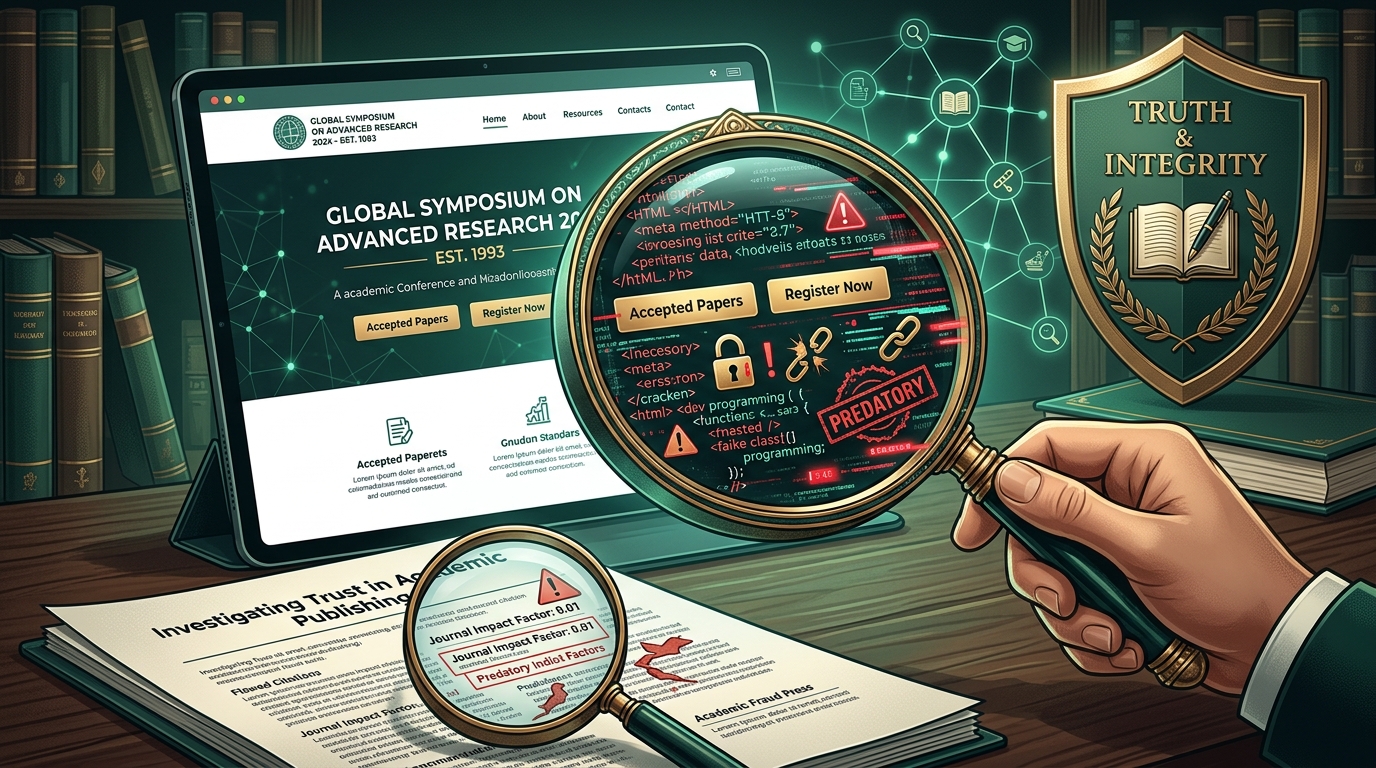
We argue that the most effective intervention against predatory conferences is a verification layer that sits between the researcher's decision to submit and the act of payment. Such a tool would perform an automated audit of the conference against a structured set of indicators — the consolidated warning signs in Table 1, expanded into an 18-point assessment — and return a risk score before the researcher commits funds or submits an abstract. The ScholarVault Conference Verification System (SCVS) implements this approach, offering a free, 18-point audit that checks conference legitimacy across domains including organiser identity, peer review transparency, committee verification, venue confirmation, fee structure analysis, and publication track record.
The advantage of a technology-assisted approach over static guidelines is that it can be updated continuously as new predatory operators are identified, and it can incorporate structured intelligence from multiple sources — regulatory filings, first-person scam reports, institutional blocklists, and community-submitted data. It also lowers the barrier to verification: a researcher who would not complete a 20-item questionnaire manually may be willing to paste a conference URL into a verification tool and receive a risk assessment in seconds.
Limitations of This Review
This review has several limitations. The evidence base is heavily weighted toward English-language sources, which may underrepresent the experience of researchers in non-English-speaking countries where predatory conferences are also prevalent. The first-person accounts we cite are publicly available and may reflect more severe cases — researchers who experienced minor disappointments are less likely to publish their experiences. We were unable to locate reliable aggregate statistics on the total financial losses attributable to predatory conferences in either the United States or Malaysia; the IAP's estimate of "billions of dollars" globally is useful as an order of magnitude but cannot be decomposed by country. Finally, our recommendation of technology-assisted verification is informed by the logical structure of the problem rather than by empirical evidence that such tools reduce predation rates, because no study has yet measured this outcome.
Conclusion
Predatory academic conferences represent a global integrity crisis that has persisted despite a USD 50 million regulatory judgment in the United States and a national-level policy study in Malaysia. The structural conditions that enable them — publish-or-perish pressure, the low cost of setting up a convincing conference website, and the jurisdictional limits of enforcement — have not changed. The most promising response is not more enforcement after the fact but verification before the fact: accessible, dynamic, technology-assisted tools that help researchers, institutions, and funding agencies distinguish legitimate scholarly events from fraudulent ones before money and reputation are committed. The cross-national comparison between the United States and Malaysia shows that both regulatory enforcement and institutional policy are necessary but insufficient on their own; the missing layer is a verification infrastructure that researchers can use at the moment of decision.
Acknowledgements
This review was prepared by the ScholarVault.in Academic Integrity Division. No external funding was received. The authors have no conflicts of interest to declare. ScholarVault.in operates the Conference Verification System (SCVS), a free 18-point conference audit tool referenced in the Discussion.
References
- InterAcademy Partnership. Combatting Predatory Academic Journals and Conferences. Rome: IAP; 2020. Available at: interacademies.org/project/predatorypublishing
- Eos. The Alarming Rise of Predatory Conferences. 2022 Sep 15. Available at: eos.org/opinions/the-alarming-rise-of-predatory-conferences
- Universiti Teknologi MARA & Universiti Kebangsaan Malaysia. A Study on the Practice of Publishing Scientific Articles by Malaysian Academics. Commissioned by the Ministry of Higher Education Malaysia; 2024–2025. Available at: ir.uitm.edu.my/id/eprint/118372
- University of Malaya Research Management Centre. Guideline on Predatory Journals, Conferences and Awards. 2024. Available at: umresearch.um.edu.my
- Thesify. Predatory Conferences: Warning Signs and How to Avoid Them. 2025 Nov 14. Available at: thesify.ai/blog/predatory-conferences-warning-signs (citing Nature investigation at nature.com/articles/d41586-024-02358-w)
- Critical Care Nurse. Predatory Conferences: Not the Meeting You Expected. AACN; 39(5):10. Available at: aacnjournals.org
- Scholarly Futures. How to Spot a Predatory Conference, Before It Costs More Than Money. 2026 Jun 24. Available at: scholarlyfutures.substack.com
- Gogotsi Y. SCAM Alert — Predatory Conference. LinkedIn post. 2026 May 7. Available at: linkedin.com
- Johns Hopkins University Sheridan Libraries. Predatory Journals and Conferences — Open Access Guide. Available at: guides.library.jhu.edu/open-access/predatory-journals
- George Washington University Himmelfarb Health Sciences Library. Predatory & Problematic Publishing: Predatory Conferences. Available at: guides.himmelfarb.gwu.edu/PredatoryPublishing/Conferences
- Villanova University. Guide to Avoiding Predatory Conferences. Available at: villanova.edu
- Malaysian Journal of Pathology. Predatory Publishers: Stay Vigilant to Protect Yourself. MJP. 2024;46(3). Available at: mjpath.org.my
- Islam MS. Cyber Scam Alert: Fake Academic Conferences. LinkedIn post. 2025 Feb 26. Available at: linkedin.com
- WASET Watch. WASET Academic Conference Scam. 2017 Oct 4. Available at: wasetwatch.wordpress.com
- Ex Ordo. 9 Warning Signs of a Fake or Predatory Conference. 2026 Apr 7. Available at: exordo.com/blog/9-signs-this-is-a-fake-conference
- Africa Check. 'This Is Actually Happening, It's a Scam': A Handy Guide to Predatory Conferences. 2023 Dec 22. Available at: africacheck.org
- Sorbye IK, et al. Is This Conference for Real? Navigating Presumed Predatory Conference Invitations. J Oncol Pract. 2017;13(7):e612–e618. Available at: ascopubs.org